 Skip-the-line available
 The History of Gripsholm Castle
From a medieval magnate's stronghold to a Carthusian monastery to Gustav Vasa's fortress — and the royal prison story that still defines the castle today.
Gripsholm's story runs from a medieval magnate through a dissolved monastery to a Renaissance fortress that became, by turn, a royal prison, a dower house, a private theatre and a national portrait gallery. Few Swedish buildings pack so many distinct chapters of royal history into a single structure, and understanding the sequence makes every room inside easier to read.
Bo Jonsson Grip's medieval stronghold
Long before the red-brick castle familiar today, this small islet in Lake Mälaren held a fortress built in the 1370s by Bo Jonsson Grip, one of medieval Sweden's most powerful noblemen. His family emblem — a griffin — gave the site its name: Gripsholm, Grip's islet. The islet's position, easily defended and commanding a stretch of the lake, made it a natural place to build.
Ownership passed through royal and noble hands over the following century: sold to Queen Margaret I in 1404, later acquired by the regent Sten Sture the Elder in 1472. Each owner left the site fortified in some form, setting up the ground Gustav Vasa would eventually build on.
None of Bo Jonsson Grip's original 1370s structure survives above ground today — the castle visible now is entirely Gustav Vasa's 16th-century building and its later additions — but the name he gave the place outlived every wall he built. Four and a half centuries of subsequent royal history all happened on an islet first chosen and fortified by a medieval nobleman's family emblem.
A Carthusian monastery on the islet
In 1498 the site was given over to a Carthusian monastery, one of the silent, contemplative orders. The monastery gave its name to the town that grew up around it — Mariefred, meaning Mary's Peace — which is still the name of the town beside the castle today. For roughly three decades the islet served a religious rather than military purpose.
That changed with the Swedish Reformation. In 1526, King Gustav I — having led Sweden's break from the Kalmar Union and founded the House of Vasa — dissolved the monastery as part of the wider reformation of the Swedish church, clearing the site for what would become his new royal castle.
The monastery's disappearance from the site is easy to overlook once you're standing in front of Gustav Vasa's brick towers, but the town's name is the lasting trace of it. Every visitor who buys a ticket to Mariefred's castle is, in a small way, still naming the Carthusian peace that once stood where the fortress now does.
Gustav Vasa's fortress, 1537
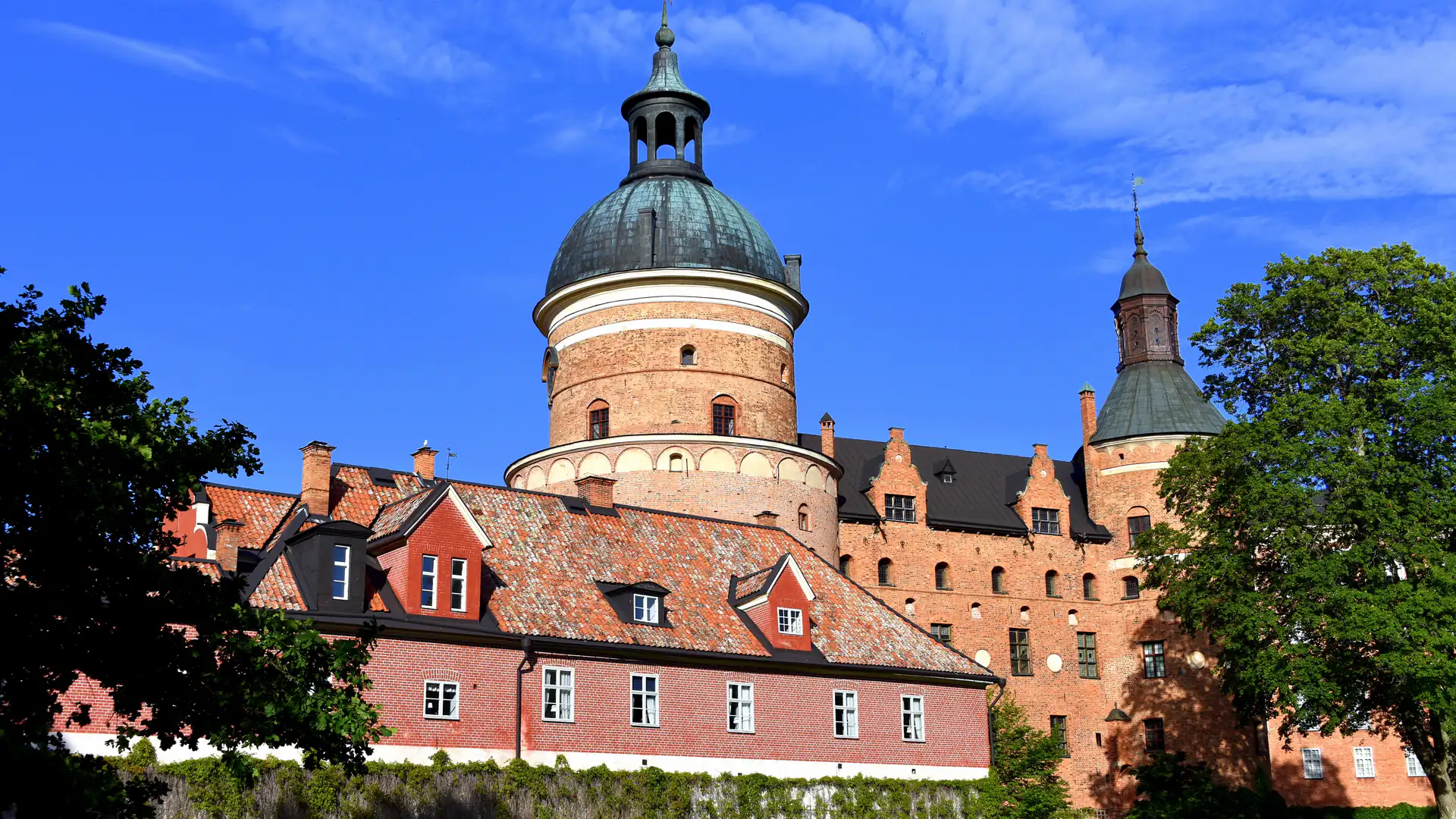
In 1537, Gustav Vasa began building a fortified royal castle on the cleared site, to a design by the architect Henrik von Cöllen. Its defining feature — four round corner towers rising from a warm red-brick body — combined genuine defensive thinking with the dynastic statement of a new royal house asserting itself after decades of Danish-dominated union politics.
The castle would go on to see significant further work over the following two centuries, with documented building activity continuing as late as 1709, reflecting the way Gripsholm was continually adapted by successive monarchs rather than finished once and left untouched.
Gustav Vasa did not live to see the castle fully finished, but the fortress he began succeeded at exactly the purpose he intended: a visible, defensible statement that the Vasa dynasty was now Sweden's ruling house, built close enough to the water to be reached and defended, and imposing enough that no visitor arriving by boat could mistake who now held power.
A royal prison under Erik XIV
Gripsholm's most dramatic chapter belongs to the second generation of Vasa kings. Between 1563 and 1567, King Erik XIV imprisoned his own half-brother, Duke John, and John's wife, the Polish princess Catherine Jagiellon, inside the castle, suspecting John of conspiring with Catholic Poland against him. Their son, born at Gripsholm in 1566, later became King Sigismund of both Poland and Sweden — a remarkable inheritance for a child born in his father's prison.
The story turned again within a few years: Erik XIV was deposed in 1568, and from 1571 to 1573 he was himself held prisoner at Gripsholm — in the same castle where he had once locked up his own brother. Later still, in 1809, another deposed king, Gustav IV Adolf, was held and signed his abdication at Gripsholm after a palace coup.
It is this repeated pattern — the castle as a place where Swedish kings imprisoned their own family, and were in turn imprisoned themselves — that gives Gripsholm its distinct character among Sweden's royal residences. Drottningholm Palace, built a century later, tells a story of settled Baroque court life; Gripsholm's 16th- and early-17th-century history is one of usurpation, suspicion and reversal, all inside the same red-brick walls visitors walk through today.
From dower house to national museum
Across the 17th and 18th centuries Gripsholm's role shifted from prison to residence. Maria Eleonora of Brandenburg, widow of Gustavus Adolphus, lived there from 1636 to 1640, and Queen Hedvig Eleonora held it as her dower residence from 1654 to 1715. King Gustav III renovated rooms for his consort Sophia Magdalena in 1773 and, in the same spirit, built his private theatre into one of the towers.
The castle's modern identity was set in 1822, when King Karl XIV Johan formally established the Swedish National Portrait Gallery at Gripsholm — the world's oldest national portrait collection — building on paintings Gustav Vasa had first gathered there three centuries earlier. A major restoration under the architect Fredrik Lilljekvist between 1889 and 1894 secured the building for its life as a public museum, the role it still fills today.
That transition from royal residence to national museum was gradual rather than sudden — the castle remained at the Swedish monarch's disposal even as its rooms opened progressively to the public and the portrait collection grew. It is this layered history, rather than any single moment of completion, that visitors are really walking through today: fortress, prison, dower house, theatre and gallery, all still standing inside the same four towers.
Reading the castle's history room by room
Because so many distinct periods left their mark on Gripsholm, it helps to know which centuries you're looking at as you move through the rooms. The four round towers and the general shape of the castle belong to Gustav Vasa's original 1537 building campaign. Duke Karl's chamber, with its 1573 frescoes, is a precise 1570s time capsule inside that older shell. The state rooms used by later residents — Maria Eleonora of Brandenburg in the 1630s, Hedvig Eleonora from 1654, Gustav III's renovations for Sophia Magdalena in 1773 — layer 17th- and 18th-century taste onto the same 16th-century structure.
Gustav III's theatre, tucked into one of the towers, is a self-contained 1770s–80s addition, while the Portrait Gallery's current form dates mostly to the 19th-century reorganisation after 1822, even though its earliest paintings go back to Gustav Vasa's own lifetime. Few Swedish buildings let a visitor trace four centuries of the same dynasty's taste this directly, room by room, within a single afternoon.
Knowing this timeline before you go turns the visit from a sequence of impressive rooms into a readable history — you can watch fortress become residence become theatre become museum, in roughly the order it actually happened, just by walking from one end of the castle to the other.
A few misconceptions worth correcting
A handful of details about Gripsholm are commonly muddled. It is sometimes assumed to be a UNESCO World Heritage Site because of its fame — it is not; that distinction near Stockholm belongs to Drottningholm Palace, inscribed in 1991, while Gripsholm's recognition rests on the National Portrait Gallery it houses rather than any UNESCO listing. Visitors also sometimes conflate Duke Karl, the future King Karl IX, with King Erik XIV's brother, Duke John, who was imprisoned at the castle — they were, in fact, two of Gustav Vasa's several sons, half-brothers to Erik and to each other's story of imprisonment and inheritance.
Another common assumption is that the castle's famous portrait collection was always housed as one coherent "gallery" from the start. In truth it grew organically from Gustav Vasa's personal commissions in the 16th century into a formally organised national institution only in 1822, nearly three centuries later — the "world's oldest" claim rests on that founding date and the unbroken continuity of the collection, not on the gallery having existed in its current form since the castle was built.
Gripsholm and the Swedish Reformation
Gripsholm's very existence is tied to one of the most consequential shifts in Swedish history. Gustav Vasa's break with the Kalmar Union in the 1520s ran alongside a break with the Catholic Church, as the new king moved Sweden toward Lutheranism and, in the process, dissolved monasteries across the country — including the Carthusian house that had stood on this very islet since 1498. Clearing that religious foundation to build a fortified royal castle in its place was not incidental; it was a direct, physical expression of the new order Gustav Vasa was imposing on Sweden.
Seen this way, Gripsholm is not just a family's castle but a monument to the Reformation itself, built quite literally on the foundations of the church power it replaced. That context adds weight to the castle's later role as a prison for royal family members, too — a dynasty that had just seized power through religious and political upheaval had every reason to guard against threats from within its own ranks, which is precisely what happened when Erik XIV turned on his own brother a generation later.
It is worth remembering this when you stand in Duke Karl's chamber or look up at the round towers: Gripsholm is not simply a beautiful old building. It is the physical record of a kingdom rebuilding its religious and political order in a single generation, with all the family suspicion and violence that process could involve.
Frequently asked
How old is Gripsholm Castle?
The current castle dates from 1537, but the islet was first fortified in the 1370s by Bo Jonsson Grip, and later held a Carthusian monastery from 1498 to 1526.
Why is the nearby town called Mariefred?
It takes its name from the Carthusian monastery once on the castle site, whose name meant Mary's Peace — Mariefred in Swedish.
Who imprisoned whom at Gripsholm?
King Erik XIV imprisoned his half-brother Duke John and Catherine Jagiellon from 1563 to 1567; Erik himself was later imprisoned there from 1571 to 1573 after being deposed.
When did Gripsholm become a museum?
Its modern identity dates to 1822, when the Swedish National Portrait Gallery was formally established there; a major restoration followed between 1889 and 1894.
Who was born at Gripsholm Castle?
Sigismund, born in 1566 to the imprisoned Duke John and Catherine Jagiellon, who later became King of both Poland and Sweden.