 Skip-the-line available
 What to See Inside Gripsholm Castle
A room-by-room guide to the state rooms, Duke Karl's untouched chamber, the National Portrait Gallery and Gustav III's 18th-century theatre.
Gripsholm packs four very different experiences behind one red-brick facade: a working 16th-century fortress, a preserved royal bedchamber untouched for four and a half centuries, the world's oldest national portrait gallery, and an 18th-century theatre frozen since its last performance. Here's what each one is, why it matters, and how to see them in an order that makes sense.
The state rooms and the four round towers
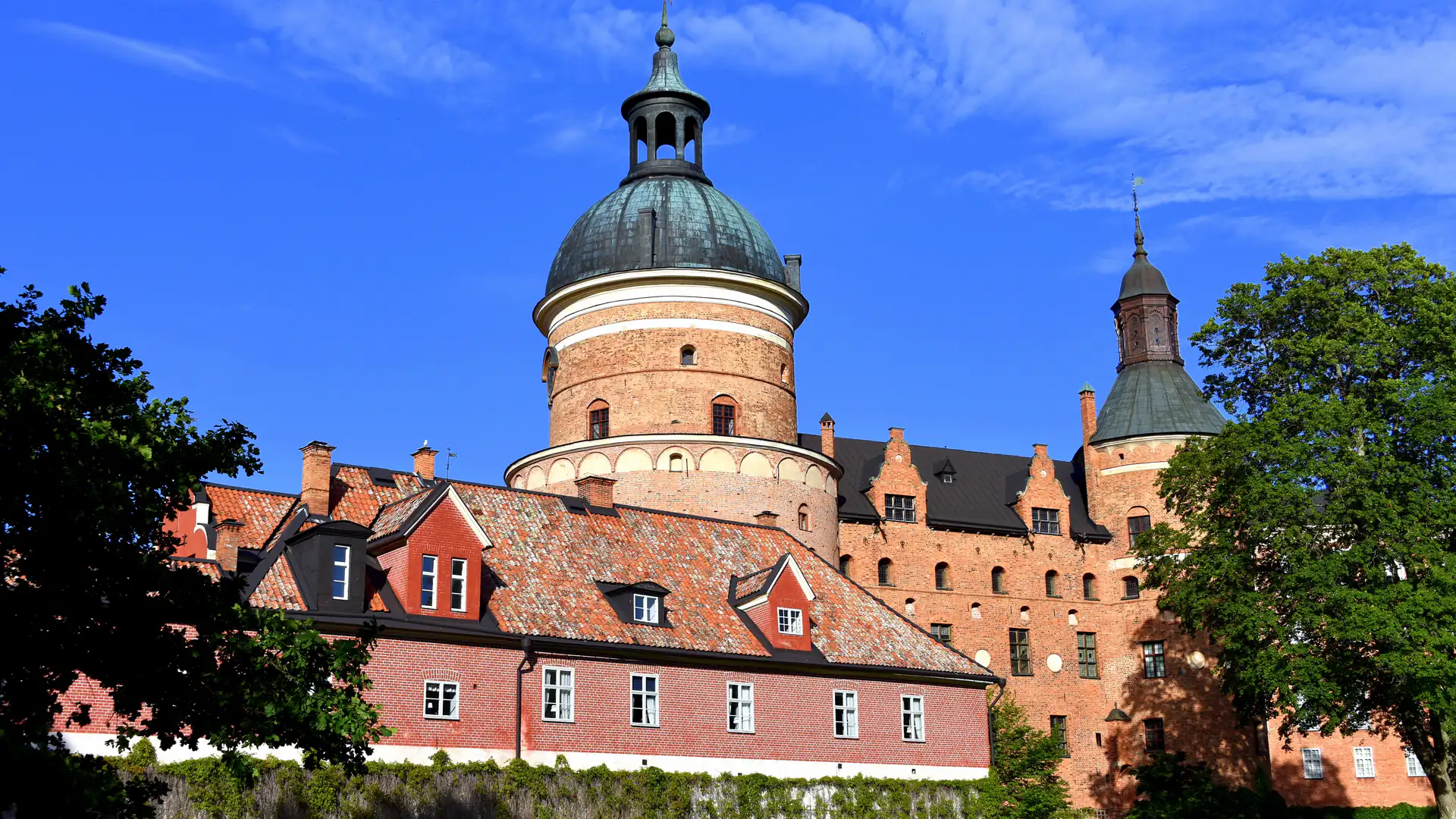
A visit begins in the state rooms, which trace the castle's use across centuries of Swedish royal life, from Gustav Vasa's original 16th-century fortress through later redecoration under his successors. The four round corner towers, thick-walled and originally defensive, thread the route together — climbing between floors, you pass through spaces that feel more like a working castle than a palace, a reminder that Gripsholm began as a fortress first and a residence second.
Look for the shift in decoration as you move through the rooms: plainer, sturdier 16th-century spaces giving way to more ornamented later additions, each generation of Swedish monarchs leaving its own layer on the building.
Several rooms carry the names of the monarchs or consorts who used them — a reminder that Gripsholm was a working residence for centuries, not a single architect's finished vision. Queen Hedvig Eleonora held the castle as her dower residence from 1654 to 1715, and later renovations for Gustav III's consort Sophia Magdalena in 1773 left their own mark on rooms you pass through on this part of the visit.
Duke Karl's chamber
The single room every visitor should slow down for is Duke Karl's chamber, fitted out in the 1570s for Gustav Vasa's youngest son, later King Karl IX. It is the castle's only fully preserved 16th-century interior — original furniture from that decade, and ceiling frescoes dated to 1573, kept exactly as they were rather than refreshed to suit later taste.
Because the room is too fragile for foot traffic, you view it through a glass screen from the doorway rather than walking inside. Take the extra minute this invites: unlike a recreation staged for visitors, this is the genuine article, and the detail rewards a slow, careful look rather than a glance in passing.
Look closely at the ceiling frescoes, dated to 1573, and at the furniture arrangement — nothing here has been rearranged for display purposes. Duke Karl went on to become King Karl IX, so this chamber captures a future monarch's private world exactly as he lived in it as a young duke, years before the crown ever reached him.
The Swedish National Portrait Gallery
Room after room of the castle is given over to the Swedish National Portrait Gallery, the world's oldest national portrait collection, formally established in 1822 but rooted in paintings Gustav Vasa gathered here in the 16th century. More than 800 works hang at Gripsholm, arranged largely floor to ceiling in the older galleries, tracing Swedish faces across five centuries from royalty and nobility through to modern cultural figures.
Rather than trying to study every canvas, pick a period or a face that interests you and follow it through the rooms; the density of the hang rewards browsing over methodical study, and a new portrait is added to the collection most years, so the gallery keeps growing even now.
The origins of the collection are older than the 1822 founding date suggests: an inventory from 1548 already lists 23 portraits among the castle's paintings, gathered under Gustav Vasa himself. Later monarchs — Karl IX, Gustav III, Hedvig Eleonora — each added their own commissions, so walking the gallery is also a walk through three centuries of royal taste in how Swedish monarchs chose to be seen.
Gustav III's theatre
Built into one of the round towers between 1772 and 1781 for the theatre-loving King Gustav III, this small amphitheatre — designed by Erik Palmstedt after Palladio's Teatro Olimpico in Vicenza — seated around sixty guests under hand-carved columns and crystal chandeliers. No performance has been recorded there since 1785, and it survives essentially frozen in time, the stage set from a production of Drottning Christina still standing as it was left.
It is a brief stop compared with the Portrait Gallery, but an atmospheric one: few 18th-century theatres anywhere in Europe survive this complete, unrestored and untouched by later use.
Architect Erik Palmstedt used the round shape of the tower itself to build the amphitheatre form, so the room's structure is inseparable from the castle around it — you are standing inside one of Gripsholm's four defensive towers, repurposed entirely for royal entertainment. The stage set still in place, from a performance of Drottning Christina, has not been struck since that last recorded show in 1785.
A suggested order for your visit
Most visitors follow a natural sequence: the state rooms and towers first, to get a feel for the castle's original fortress character; Duke Karl's chamber next, while your attention is still fresh for its quieter details; the Portrait Gallery in the middle of the visit, where you can take your time without racing a clock; and Gustav III's theatre as a striking, compact finish.
If you're joining the daily 15:00 English guided tour in summer, treat it as a chance to revisit highlights with expert commentary rather than your first look — arriving earlier to see the rooms independently first makes the guided hour far richer.
What to look for beyond the four highlights
Beyond the state rooms, Duke Karl's chamber, the Portrait Gallery and the theatre, Gripsholm rewards visitors who pause in the connecting spaces too — stairwells set inside the round towers, older furnishings kept in less formal rooms, and window views back across Lake Mälaren that explain why this particular islet was fortified in the first place, as far back as the 1370s.
The castle also keeps its own small collection of curiosities alongside the grander highlights, including objects tied to the building's long use as a royal residence rather than purely as a museum piece. None of this needs a special detour; it simply rewards visitors who don't treat the four headline rooms as the entire visit.
How the highlights connect to the castle's history
Each of Gripsholm's four highlights ties back to a different moment in the same story. The state rooms and towers are Gustav Vasa's 1537 fortress itself, the dynastic statement that started everything. Duke Karl's chamber belongs to the next generation — the same family, a generation on, living inside the walls their father built. The Portrait Gallery spans the whole span of that family's rule and beyond, added to continuously from the 16th century to the present. And Gustav III's theatre belongs to a much later, calmer century, when a secure monarchy could afford to build purely for pleasure.
Seeing the four highlights with that timeline in mind changes how the visit reads: not four unrelated curiosities under one roof, but four different centuries of the same royal family leaving their mark on the same building, fortress giving way eventually to theatre and gallery as the castle's purpose softened over time.
Accessibility inside the castle
Gripsholm is a genuine 16th-century fortress rather than a purpose-built modern museum, so accessibility is a mix of thoughtful provision and inherent historic constraint. The four round towers were built with spiral stairs typical of their era, and some routes between rooms involve steps or uneven historic flooring that cannot be fully levelled without compromising the building itself.
The main state rooms and the Portrait Gallery's principal spaces are generally navigable for most visitors, though the full route through every tower and chamber is not entirely step-free. If you or someone in your group has specific access needs, tell us when you book and we will share the current guidance on step-free routes and available assistance, so you can plan realistically before you travel rather than discovering a limitation at the door.
Seating is available at intervals for visitors who need to rest partway through, and the overall route, while not short, is not so long that a steady pace becomes exhausting. Most visitors comfortably manage the full route in the 1.5 to 2 hours suggested elsewhere in this guide, even without rushing.
Photography and etiquette inside the castle
Photography without flash is generally allowed throughout the state rooms and the National Portrait Gallery, letting you capture the towers, the hung portraits and the general atmosphere of the rooms as you move through them. Flash photography, tripods and selfie sticks are not permitted, both to protect centuries-old paintings and furnishings and out of consideration for other visitors in rooms that are not especially large.
Duke Karl's chamber is a special case: because you view it through a glass screen rather than entering, reflections can make photography tricky, and a slower, more patient approach — angling your phone or camera to avoid the glare — usually works better than a quick snapshot. It is worth simply looking properly at this one room rather than experiencing it entirely through a screen.
As in any historic royal building, keep voices low in the smaller rooms, follow any staff guidance about which spaces are open on a given day, and treat the furnishings — even where not roped off — as objects to be looked at rather than touched. These are ordinary courtesies rather than strict rules, but they keep a visit pleasant for everyone sharing the rooms with you.
Bags may be subject to a quick check at the entrance, as at many staffed heritage sites, so travel reasonably light. There is no formal dress code, though the castle's rooms can feel cool even in summer, so a light layer is worth carrying regardless of the weather outside.
Frequently asked
What is the most famous room in Gripsholm Castle?
Duke Karl's chamber, the castle's only fully preserved 16th-century interior, with original 1570s furniture and 1573 ceiling frescoes.
How many portraits are at Gripsholm Castle?
More than 800 works from the Swedish National Portrait Gallery hang at Gripsholm, part of a wider national collection of around 5,000.
Can I go inside Gustav III's theatre?
You can enter the auditorium and view the stage; performances have not been held there since 1785, so it is preserved as a historic space rather than an active theatre.
Is Duke Karl's chamber open to walk through?
No — it is viewed through a glass screen because the original furniture and frescoes are too fragile for foot traffic.
Who designed Gustav III's theatre?
The architect Erik Palmstedt, working between 1772 and 1781, drawing inspiration from Palladio's Teatro Olimpico in Vicenza.