 Skip-the-line available
 Gripsholm Castle vs Drottningholm Palace
Two very different royal Mälaren islands — a Renaissance fortress with a prison and portrait gallery, and a Baroque UNESCO palace with formal gardens. Here's how they compare.
Stockholm sits close to two of Sweden's most visited royal residences on Lake Mälaren — Gripsholm and Drottningholm — and travellers with limited time often want to know which one to choose. They could hardly be more different in character: one a working 16th-century fortress with a prison story, the other a UNESCO-listed Baroque palace with formal gardens. Here's how they actually compare, and how to decide between them.
Two centuries, two styles
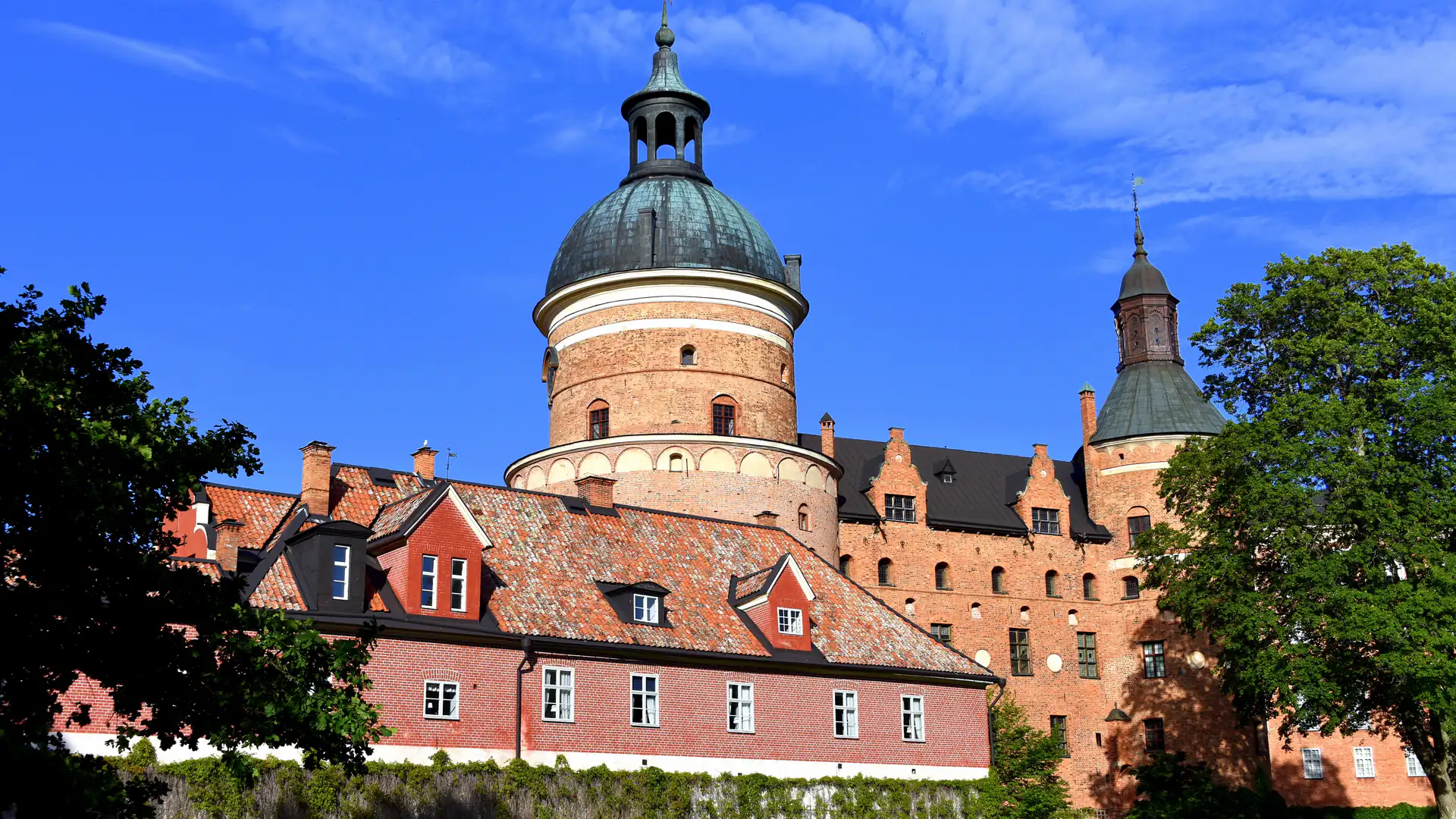
Gripsholm Castle is a Renaissance fortress, begun in 1537 by Gustav Vasa: warm red brick, four round defensive towers, and interiors that still carry the weight of a working 16th-century royal residence. Drottningholm Palace, by contrast, is a Baroque and Rococo palace begun more than a century later, in the 1660s, for the dowager queen Hedvig Eleonora — a building conceived from the start as a showpiece of European court architecture rather than a fortress.
Walking through Gripsholm feels like moving through Swedish history in layers, from fortress to prison to gallery. Walking through Drottningholm feels like stepping into a single, unified vision of 17th- and 18th-century royal taste, planned and executed with far more consistency.
Even the building materials tell the story: Gripsholm's warm red brick and round defensive towers speak to a dynasty still consolidating power after decades of union politics, while Drottningholm's ochre-painted Baroque facade, designed by Nicodemus Tessin the Elder and completed by his son, speaks to a monarchy secure enough to build purely for ceremony and comfort.
Status and recognition
Drottningholm Palace holds a distinction Gripsholm does not: it was Sweden's first UNESCO World Heritage Site, inscribed in 1991, recognised as the country's best-preserved royal palace of its era. It remains a residence of the Swedish royal family today, who live in one wing.
Gripsholm carries a different kind of international recognition: it houses the Swedish National Portrait Gallery, the world's oldest national portrait collection, founded in 1822. Where Drottningholm's fame rests on its architecture and gardens as a complete ensemble, Gripsholm's rests on specific rooms and objects — a preserved 16th-century chamber, an intact 18th-century theatre, a collection of faces spanning five centuries.
Neither site needs the other's credentials to justify a visit, but the contrast is worth knowing before you choose: Drottningholm's UNESCO status signals a complete, internationally benchmarked ensemble, while Gripsholm's reputation rests on the density of genuinely rare, specific things packed into one building — a different kind of significance, not a lesser one.
What each ticket covers
A Gripsholm ticket is date-only: you choose the day, not a fixed hour, and move through the state rooms, Duke Karl's chamber, the Portrait Gallery and Gustav III's theatre at your own pace. Drottningholm's Palace ticket is a timed-entry ticket for a specific window into the Baroque state rooms, with a combined ticket available in season that adds the Rococo Chinese Pavilion out in the park.
Drottningholm's free formal gardens and English landscape park are a significant part of any visit and need no ticket at all. Gripsholm has no equivalent large formal garden to wander — its grounds are more modest, and the visit is concentrated almost entirely inside the castle walls.
That concentration is itself a difference worth weighing: a Gripsholm visit is compact and indoor-focused, ideal on a wet or cold day, while a Drottningholm visit can easily fill a half-day between the state rooms, the pavilion and a slow walk through the gardens when the weather cooperates.
Getting there, and the seasonal calendar
Drottningholm is the easier of the two to reach on short notice: about 30–45 minutes from central Stockholm by metro and bus year-round, with a seasonal summer ferry as a scenic alternative. Gripsholm is further out, at Mariefred roughly 60 km from the city, reached by a multi-hour historic steamboat in season or by train and bus year-round — a bigger commitment of time either way.
The two also keep different calendars. Drottningholm is open on a reduced schedule even in winter, most days of the week. Gripsholm's low-season opening shrinks much further, to weekends only, with a full closure around Christmas and New Year — worth checking carefully if your trip falls outside the mid-May to mid-September high season.
If your Stockholm trip is short and falls in winter, this difference can decide the question for you: Drottningholm remains genuinely visitable most days, while Gripsholm demands a weekend and a longer journey out to Mariefred.
Which should you choose?
If you have time for only one Mälaren royal site and want an easy half-day from central Stockholm, a famous UNESCO ensemble, and formal gardens to walk for free, Drottningholm is the more convenient choice. If you're drawn to a more intimate castle with a genuine prison story, a single untouched 16th-century room, and the world's oldest portrait gallery — and you have a full day and enjoy the journey as much as the destination — Gripsholm is the richer, quieter visit.
Many visitors with enough time do both on separate days: Drottningholm as a shorter city-adjacent outing, Gripsholm as a fuller day trip built around the steamboat or the train-and-heritage-railway route through Mariefred. Neither replaces the other; they show two different centuries of the same royal family.
If pressed to choose one on a first Stockholm trip, let the calendar decide as much as personal taste: Drottningholm's wider year-round access makes it the safer single choice on a short or off-season trip, while a summer visit with a full day to spare tips the balance toward Gripsholm's richer, more surprising story.
The royal family that connects them
The two castles are not unrelated curiosities but chapters in the same story. Gripsholm was built by Gustav Vasa, founder of the House of Vasa, in 1537. Drottningholm was commissioned more than a century later by Hedvig Eleonora, a dowager queen of the same Swedish crown, after an earlier house on that site burned down in 1661. Between them, the two buildings span roughly a century and a half of how Swedish monarchs chose to build, from defensive fortress to unguarded ceremonial palace.
Visiting both, even on separate trips, gives a clearer sense of Swedish royal history than either does alone: Gripsholm shows a dynasty establishing and defending its power through imprisonment and fortification, while Drottningholm shows the same dynasty, generations later, secure enough to build purely for beauty and to keep building right up to the present — the Swedish royal family still lives in one wing of Drottningholm today, a living link this history never quite lets you forget.
Sample day plans for each site
A Gripsholm day typically runs: morning departure from Stockholm by steamboat or train, arrival in Mariefred by late morning, 1.5 to 2 hours inside the castle covering the state rooms, Duke Karl's chamber, the Portrait Gallery and the theatre, lunch or a coffee in Mariefred's town centre, and a return journey that, by steamboat, can take up the whole remainder of the afternoon. Build the whole day around this one destination rather than trying to fit in a second stop.
A Drottningholm day is more compact and flexible: a 30–45 minute journey each way by metro and bus, or a scenic summer ferry, 1 to 1.5 hours for the Palace state rooms, and as much additional time as you like walking the free formal gardens and landscape park, with the seasonal Chinese Pavilion added in warmer months. Because the journey is shorter, a Drottningholm morning can comfortably be paired with an afternoon back in central Stockholm.
If you have the luxury of a longer Stockholm stay, giving each site its own separate day — rather than trying to compress both into one — lets you enjoy both at their own pace, without either becoming purely something rushed between transport connections.
Other Mälaren castles worth knowing about
Gripsholm and Drottningholm are the two best-known royal sites on Lake Mälaren near Stockholm, but they are not the only historic estates on the lake worth a mention when planning a wider trip. Taxinge Castle, an 1813 manor south of Stockholm on a promontory at Gripsholm Bay, is reachable from Mariefred by the same heritage steam railway that serves Gripsholm, and is known less for royal history than for one of the largest cake buffets in northern Europe.
Strängnäs, a little further around the lake, holds a different kind of significance: its Gothic cathedral was where Gustav Vasa was elected king in 1523, the founding moment of the very dynasty that built Gripsholm fourteen years later. None of these sites competes directly with Gripsholm or Drottningholm for a first-time visitor's attention, but together they show how much Swedish royal history is layered around this one lake, within easy reach of a single Stockholm base.
For travellers with more than a few days in the region, threading Gripsholm, Drottningholm and one or two of these smaller sites together across a longer stay gives a far fuller picture of Swedish royal history than any single visit can — fortress, palace, cathedral and cake castle, each adding its own piece to the same story of one dynasty and one lake.
None of these smaller stops need to be booked as rigidly as Gripsholm itself, since they don't share its strict seasonal opening pattern in the same way. Treat them as flexible additions once your Gripsholm date is fixed, rather than fixed points you plan the whole trip around.
Frequently asked
Is Gripsholm Castle or Drottningholm Palace better?
They suit different trips: Drottningholm is an easier, UNESCO-listed half-day from central Stockholm with free gardens; Gripsholm is a fuller day trip with a Renaissance prison story and the world's oldest portrait gallery.
Is Gripsholm Castle a UNESCO World Heritage Site?
No. Drottningholm Palace holds that distinction, inscribed in 1991 as Sweden's first UNESCO site; Gripsholm is not UNESCO-listed.
Which is closer to Stockholm, Gripsholm or Drottningholm?
Drottningholm, about 30–45 minutes from central Stockholm. Gripsholm is further, at Mariefred roughly 60 km away.
Can I visit both Gripsholm Castle and Drottningholm Palace in one trip?
Yes, though most travellers visit them on separate days given the distance and different opening calendars, especially outside Gripsholm's daily summer season.